
Sex Offender Checks in Simpson County
The Kentucky State Police Sex Offender Registry is the authoritative state search for Simpson County. It supports name and place-based routes, including county, city or ZIP, street address, radius, and map or list views. Kentucky State Police and local law enforcement provide the compliance layer, while the U.S. Department of Justice national service provides a broader cross-state search.
Start with the type of fact actually known. Choose Simpson County for a broad local list, use an address and radius for neighborhood awareness, or use a name only when the identity is known. Results should then be checked against the official profile's photo, physical description, address context, qualifying offense, and status. No unofficial list is needed for this task.
Simpson County Address and Radius Searches
A Simpson County address-radius query answers a different question than a name search. It looks for public registry locations around a point entered by the user. The radius control depends on an address search, and the exact distance choices can change as the portal interface changes. A map view helps show spatial relationships, while a list view is easier to compare line by line.
A clear result is not a safety guarantee. An address may fall outside the selected radius, an update may still be moving through the system, or a person may not be subject to public Kentucky registration. Use the result as one source for awareness, apply ordinary safety practices, and revisit the official portal when current information matters.
How to Search the Kentucky State Police Sex Offender Registry
A Simpson County registry search may require a user to read and accept its conditions before reaching the controls. Those conditions are part of the official process and should not be bypassed. Search fields allow a known identity to be checked separately from a location, which helps avoid treating every result in Simpson County as a match to a single person.
- Open the Kentucky State Police registry and read or accept the conditions shown by the live portal.
- Select Simpson County, enter a city or ZIP, use an address-radius search, or enter a known name.
- Review the list or map and open only the profiles that may fit the intended search.
- Compare the profile's photo, descriptors, address, status, offense information, and update context before drawing a conclusion.
| Field Label | Type | Required | Notes |
|---|---|---|---|
| Last, First, Middle Name | Text | Search dependent | Used when a person's identity is already known. |
| County | Dropdown | No | Select Simpson for a county-filtered result. |
| City or ZIP | Text/dropdown | No | Narrows a geographic search within the state registry. |
| Street or Address | Text | For address search | Provides the center point for a proximity search. |
| Radius | Dropdown | Address dependent | Live distance choices should be rechecked because the interface can change. |
| Map or List | View control | No | Changes how the same geographic results are presented. |
Simpson County Sheriff Registration Contact
The Simpson County Sheriff is the local law-enforcement contact for registration duties. The official county roster places the office at 203 E. Kentucky St., Franklin, Kentucky 42134, and lists 270-586-7425. The public research does not establish an appointment schedule, registration fee, or exact check-in frequency, so a registrant should call the sheriff for current instructions rather than infer a deadline from a general web summary.
Registration duties can include initial registration and timely reports of changes or verification through designated agencies. The sheriff's records information is a separate request channel, while the public KSP search is the awareness tool. Neither is the place to guess how a change must be filed. Suspected noncompliance should be reported to Kentucky State Police or local law enforcement. Emergency conditions go to 911, while routine questions and reports should use the appropriate agency contact.
Inside a Registry Profile
A Simpson County registry profile brings several identifying and statutory fields together. None should be used alone. A shared name, an old address, or a partial physical description can produce a mistaken identification. Compare the whole profile and note whether it reflects a current compliance or verification context.
| Name & Aliases | Lists the public identity fields and alternate names recorded for dissemination. |
|---|---|
| Photo & Physical Description | May include a photograph and physical traits used to distinguish people with similar names. |
| Registered Address | Shows address information Kentucky law allows the registry to display. |
| Offense & Statute | Identifies qualifying offense information, conviction details, and cited law when included. |
| Vehicles & Marks | May include vehicles and scars, marks, or tattoos recorded for public dissemination. |
| Registration Status | Can show compliance or registration context that must be read with available update information. |
Reading Simpson County Profiles Carefully
To read a Simpson County profile, begin with the photo and physical descriptors, then compare the city or address, aliases, status, and offense information. Do not assume the nearest map point is the person sought, and do not treat an alias as proof of a separate identity. A vehicle or distinctive mark can help distinguish profiles, but only when the official record displays it.
Update timing matters. Registration information can move from a county contact to state systems and then into a national search on different schedules. If a key detail looks inconsistent, use the KSP registry as the Kentucky authority and contact KSP or the Simpson County Sheriff for a compliance concern. Do not publish or copy a private registrant value into a new list.
Kentucky Registration Levels and Requirements
Simpson County registrants follow Kentucky's statutory categories, not a simple low, medium, or high risk label. KRS 17.520 sets a lifetime category for the aggravated, repeat, and other listed circumstances named in the statute. Other covered registrants generally register for 20 years from the statutory start point. Tolling, restart rules, and a person's exact category require the current statute and official record.
| Kentucky Category | Duration | Verification and Public View |
|---|---|---|
| Lifetime-registration categories listed in KRS 17.520 | Lifetime | Follow statutory duties through designated agencies; qualifying public fields may appear in the KSP registry. |
| Other covered registrants | 20 years from the statutory start point | Call the Simpson sheriff for current local reporting instructions and verify the live public profile. |
A federal SORNA tier is not a substitute for Kentucky's public statutory category. Duration should never be guessed from an offense label alone, and registration status should not be inferred from a court docket without checking the registry.
Simpson County Registry Versus NSOPW
For Simpson County, the National Sex Offender Public Website adds a nationwide search layer. It is useful when a location lies near a state line, when a person may have moved, or when a name search needs coverage beyond Kentucky. NSOPW sends users back to the contributing jurisdiction and can reflect different update timing from the KSP registry.
The successful assigned image below shows the official federal search source without displaying or preserving any private registrant profile.
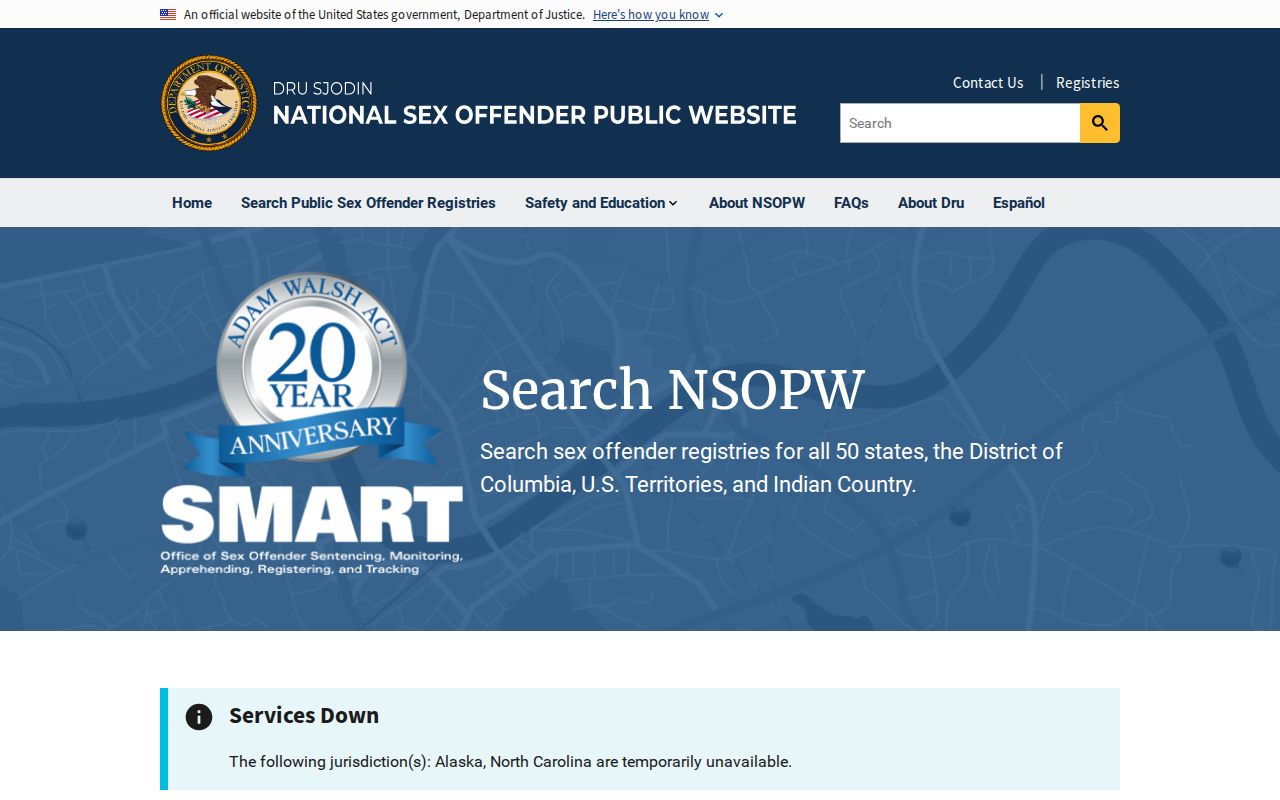
For a Kentucky location, the KSP profile remains the key record to read. NSOPW broadens the area searched but does not turn a national result into a separate Kentucky finding.
Registry Absence in Simpson County
Registry absence in Simpson County cannot establish that an area is free from risk. Kentucky's registry covers people who meet its legal registration rules and displays information authorized for public dissemination. A person may have a criminal record without being subject to sex-offender registration, and an empty radius result does not prove that no safety concern exists nearby.
Search limits also affect conclusions. A misspelled name, too-small radius, old city, or update lag can change the visible result. Try the appropriate place-based and name-based routes, confirm the search settings, and return to the official portal. General household and community safety practices should not depend on a single database result.
The Simpson County government directory provides the local agency route when a user needs to confirm which office serves an address. It does not replace KSP's statewide registry or create a county-run registry. That separation helps keep a public lookup, a registration duty, and an agency report from being confused with one another.
Reporting Simpson County Registry Concerns
Suspected noncompliance belongs with law enforcement, not social media or private confrontation. Give KSP or the Simpson County Sheriff the official profile reference and a clear description of the concern. An address mismatch or status question should be reported as a question for verification, not announced as a proven violation.
This route protects accuracy and personal safety. The agency can compare information that is not public, determine whether an update is pending, and decide whether any enforcement step is warranted. Call 911 only when there is an emergency. The registry itself is for awareness, while investigation and enforcement remain government functions.
Keep a Simpson County registry report factual. Note the official profile being referenced, the field that appears inconsistent, and when the issue was observed. Do not follow a person, enter private property, or try to test compliance. Those acts can create danger and can interfere with a lawful investigation. A registry concern is best handled as information for trained authorities, not as proof posted to a neighborhood group.
Community Notification and Lawful Use
KRS 17.580 authorizes Kentucky's public registry dissemination for community awareness. That access does not authorize threats, intimidation, harassment, retaliation, or vigilantism against a registrant, family member, household, or property. KSP's registry warnings prohibit misuse, and information should be used for lawful personal and community safety planning.
Misuse can be a crime: KRS 17.580 governs public dissemination, and KSP warns that registry information may not be used to harass or threaten. Misuse can lead to criminal prosecution; report concerns to law enforcement instead of confronting a person.
Note: Registry publication is a safety notice, not permission to punish, exclude, or target a person outside lawful government action.